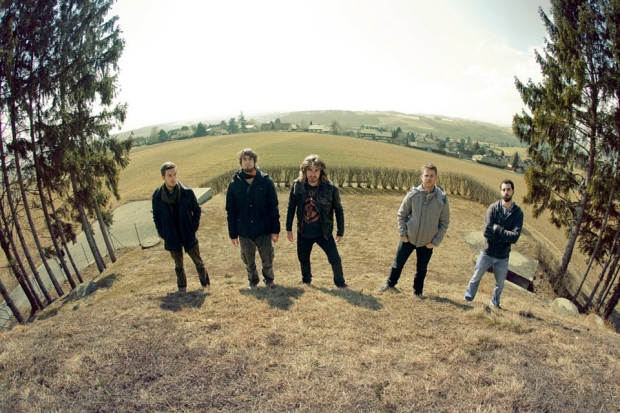


Richard Ingemann from Mosher zine and Ramon Calvo from Lukinzine have been working on a secret project for the past 6 months, and have chosen me to be their . Ladies and gentlemen, these guys have just started a new record label called Farsot! I did this feature and conducted an interview with these decent fellows to force you to pay attention to their work. I promise you won’t regret it! Here’s the birth of a new dedicated duo putting 101% of their effort and passion to this new undertaking.
Together with La Familia Releases (DISFEAR, WOLFBRIGADE, KYLESA, VICTIMS, and more) they will release a new LP by WE LIVE IN TRENCHES called “Life Crisis” later this year! Learn more about their relationship with the band and a ton more information in this in-depth interview below.
Richard, Ramon… thanks so much for your work. Keep it up, I beg you!

Hi, guys! Good to have the opportunity to talk to you. Please introduce yourselves and tell us what is FARSOT?
Ramon:
Well, I am Ramon and I have been running the webzine Lukinzine for a couple of years now, and just felt it was a natural step to combine it with starting a record label. I talked to Richard about it, for the brief while he lived in the same town, and he kind of felt the same. I guess that’s how the ball started rolling.
Richard:
And my name’s Richard Ingemann, who as well as Ramon have been writing about music in a webzine called Mosher for about two years now. The idea of starting a record label seemed, as Ramon said, like a natural step to evolve and further develop my biggest passion – music. While at the same time leaving some sort of mark in music history. Something for me to be proud of.
Ramon:
As for the actual label the idea is to base it on the standards of DIY, and keep it all grounded but focused. You don’t have to have the best or most original of ideas to make it, you just have to have the will and passion to make an idea come true. When we do something as Farsot we want to put our heart, soul and pride into it. I mean, the product is something that will reflect on us as persons and thus should be something that we can stand behind for the rest of our lives and beyond. For me, as a music enthusiast and record collector extraordinaire, the packaging of an album is an extension of the listening experience, and this is why we will be very involved and caring when it comes to every aspect of the albums we release. The music is important, but so is the packaging and the feel of having something unique and physical in your hands, and this is something that sadly many labels seem to have forgotten today.
Richard:
I also look forward to meeting new and old faces on gigs and other music related forums. The aim of Farsot is to release great music with great packaging together with our DIY mentality. With that being said, people can expect meeting us on gigs with our Farsot distro. Bringing it back to basics, 90’s style. I’m in it for the people, scene and music. Nothing else. Regardless of genre, really.
Ramon:
That’s something really important for us, and something that I personally really miss. The distros at shows, like back in the days when all bands travelled with at least two cases filled with vinyl records from labels, bands and people they had met on the road. That’s a fantastic and very down to earth way to spread the music and I really enjoy sifting through those beaten up cases and talking to the merch guy or the bands about different records I had never heard or seen before. So, like Richard mentioned, that’s what we’re aiming for. Taking it back to basics and building a distro together with the people who happen to cross our path on this voyage known as Farsot.
Great, guys. Can’t wait to dig deeper [smiles] But before we do that, please tell me why did you decided to name the new project “Farsot”?
Richard:
Oh, the name discussion. The horror! I think we had about 30-something different suggestions of record label names. All in English, nothing really felt right. Then, since we’re both from Sweden, we started to discuss the idea of having a Swedish name for the label. I think it took us about 1-2 weeks until we settled for Farsot, which is the word for “plague” in Swedish.
What disaster are going to send on us? [smiles]
Ramon:
That depends. If you’ve got a great taste in music then there’s no need to worry, because that’s what we’ll be releasing upon the world. Great music. Period. But if you don’t have taste buds that reach from the furthest pits of hell to the highest points of heaven then this plague we’re bringing to the table will devour your soul until you finally get what we’re all about.
Ok, I’m in [smiles]. Back to your strategy, guys, do you plan on selling your stuff at local shows only? Or will you be travelling will your fellow bands when possible?
Ramon:
The main idea is to make the albums we release as available as possible, so to answer your question: yes, we will definitely be travelling with the bands to shows when the time allows it. We will also be attending as many local shows as possible, and make our hopefully ever growing distro available in that way too. There will of course also be an online store, so the folks that live in remote places where bands never play also will have a crack at the gold. By the way, if anyone has a distro, no matter how small, they can get in touch and we’ll work something out.
So what’s your initial release? Will you be releasing it exclusively?
Richard:
Our FARSOT001 will be the “Life Crisis” LP by WE LIVE IN TRENCHES, released together with La Familia Relases. We couldn’t be more happy than releasing the second album by this great band together with Stachel who’s put out some high quality stuff by KYLESA, DISFEAR, WOLFBRIGADE, HERÄTYS, URSUT, MARTYRDÖD… the list goes on and on.
Tell us more about the band. How come they got 10/10 in Lukinzine? There’s no such thing as 10/10 [laughs]
Ramon:
[laughs] You’re right there really is no such thing. Or is there? The thing with this particular release, which was WE LIVE IN TRENCHES debut EP “Autonomy Clinic” was that I had never heard of them at all. I even thought the name was pretty lame, so my expectations were very low when I let the needle touch the vinyl. When the “Nervous breakdown”-ish guitars hit me together with that pissed of voice I was pretty stunned, to say the least. It was the perfect mix of 80’s and 90’s dirty hardcore with that political nerve to it, and after reading the lyrics I was completely won over. Raw, dirty and naked aggression that comes from both the heart and mind is almost always a 10 out of 10 in my book.
Fair enough [smiles]. I really need to get to know them better. Do you already have some plans or at least ideas for more releases? Who’s gonna be the number 2? [smiles]
Ramon:
Long before we even decided that WE LIVE IN TRENCHES was going to be our first release we had a very long list of interesting bands we’d love to work with. We probably had three or four label meetings that were just focused on discussing bands and why we actually liked them. Some bands were long shots, and no I’m not giving away any names, but we thought that we always could give it a try even if it seemed impossible. The first plan was actually to revive an old 90’s compilation that has never seen the light of day on vinyl, but those plans got shot down by a person who owned a percentage of the rights, but we’re thinking about giving it another shot in the future. Give up? No way, not us!
As for which release is going to be number two, there are just some very light plans at the moment so we’re keeping it on the down low for now.
Oh come on, admit you’re gonna work with the reunited JUDGE? [smiles] By the way, what are your thoughts on yesterday’s big news?
Ramon:
I actually don’t have that big of a problem with reunions as many people seem to have, as long as they’re done for the right reasons. To just do a fast cash grab and pretend like it’s 1988 again may be fun at the time for some bands, but could also ruin all the things they’ve actually built up. So to answer you I guess it’s great for Judge, and I would definitely see them if I got the opportunity, but in the long run I will always rather see an active and hungry band than a reunited one.
Richard:
I concur. And who are we to judge what is the so called “right reasons”? People really should try being a little more open-minded and stop trying to maintain some sort of “ideal” of how a scene should or should not be. A reunion takes guts because people will always compare the band to its former glory days. But as Ramon pointed out, I as well will rather see a hungry band from today than a reunited one.
Now you’re talkin’! You’re god damn right, fellas!
Back to your catalog, I was just about to ask you about compilations. I guess you’ll be putting together your own collections, as well?
Ramon:
We have some ideas we’re pretty stoked about when it comes to compilations, but that is something we’re keeping to ourselves at the moment.
Richard:
Indeed, we have some ideas for future compilations but as for now we’d rather focus on getting the WE LIVE IN TRENCHES LP just right. Keep in mind that we are yet to release our FARSOT001. Future compilations and other ideas will have to wait. But yes, we do have some exciting ideas we’ve talked about doing sometime in the future. So hold that thought.
Alright. Back to La Familia Releases. How exactly will you be cooperating with the label?
Ramon:
Well, we’ll be doing just about everything together with Stachel over at La Familia, which means we’ve been working out the details about how it’s all going to look, quantities, colors and so on. We’re pretty much splitting the work down the middle and discussing our way to an agreement on everything. It has actually been really easy, since everyone involved has pretty much the same idea about how a good packaging and vinyl should look, sound and be. Of course the band is involved in the discussion of it all too, since it’s actually their album and we as labels are “just” making it available.
Richard:
The band do what they are good at and ought to do, which is making great music. And we as record labels do what we are good at and ought to do, which is promoting and putting it out there. As it should be, we’re in this together.
Alright, so you won’t be just a distributor, but a full scale producer, right? Discs, exclusive packages, etc.?
Richard:
That’s right. Our intention with Farsot is making high-quality releases. And that means having control on the entire release in question. Meaning from the music itself to the nerdy stuff like sound quality, sleeve design, paper quality, vinyl colors, exclusive material and so on. The entire package that we give a catalogue number! And that includes promoting the band and music before, during and after the release itself. What our bands and fans will get with Farsot is a solid, high-quality package deal. We can’t stress this enough but we’re music enthusiasts, so putting something out there won’t happen until we’re perfectly satisfied with the result. And our hope is that people will appreciate and notice that.
How exactly do you plan on promoting your bands before, during and after the release itself?
Richard:
Being a small record label with a limited budget you basically have to be innovative and dig where you stand. It may sound pretentious promoting the bands before, during and after a release. But the thing is we don’t believe in just launching a webshop, write a little something that a new release is coming and then remain passive when it’s release day. As I pointed out before, we’re in this for the music, scene and people. And that means meeting new and old faces, bring our distro to shows and talk to people (on gigs, Facebook and Twitter, via e-mail, telephone, Skype or whatever) if we could help each other out. Be that a fan, band or a gig organizer. “Promotion” is, for me, not about boasting single-way communication. It’s about having a dialogue. But the premise will always be to meet, talk and listen to people. Be humble, remain honest and don’t be afraid of asking for help. I think that’s key. Without support and help Farsot will and cannot exist. Period.
Ok, but apart from Farsot releases you’ll be selling a bunch of other stuff, right? Will there be a lot of it? What are your sources?
Ramon:
I guess you mean the distro? Well, as we stated before it will be a gathering process from all the people we meet along the way while working with Farsot. The idea is to help each other out and get our music out there while helping others to get their music out there as well. In other words if the distro will contain more than music is something for the future to tell, but at the moment the plan is to just have physical albums and EPs in it.
Alright, back to your catalogue, how do you take care of design and graphics? Who do you work with?
Richard:
For the Farsot logo we worked with Andreas Frisk from Thank You Satan, who previously had the much appreciated KRANIUM record label and who’s been working quite a lot with the designs for NITAD. Thankfully Robert Samsonowitz, guitar player in WE LIVE IN TRENCHES, is a very talented graphic designer and will be doing the forthcoming “Life Crisis” sleeve design. We’ve seen some of his sketches and we can promise you a very dark design with some JOY DIVISION influences to it. For future releases we’ll work with different designers or talk to the band in question if they have any ideas.

Cool. You mentioned about “a modern twist” in your official introduction. Any plans for unconventional, virus or social “marketing” actions?
By the way, how useful do you think social media is for up-and-coming labels?
Richard:
For now, we’re mainly working out the details of how the coming LP will sound, look and feel. Marketing and promotion is important, indeed, but the quality of the LP is equally important. I may have some ideas of what we could do when the time is right but for now we just have to focus on getting what really matters just right. All the marketing in the world cannot save us if we release something that people get disappointed at, so we have to begin in the right end. And that is and always will be the thing we give a catalogue number. But sure, we’ll work hard on trying to get people excited about the “Life Crisis” LP. Because it’ll be quite something, I assure you. I’ve had my share of hours with the album in question and it really grows on you, I can tell you that.
I think social media today is important for the majority of record labels, not just the independent and up-and-coming ones. But far from all labels use it the way it perhaps should be used. And that is, regardless of medium really, having a dialogue. A lot of record labels, or companies for that matter, use social media as just another broadcasting channel. And that’s missing the whole concept of “social media”. Thing is, it’s missing the whole idea of what communication is. And that will always be having a dialogue. In media in general today it’s a lot of “Me! Me! Me!” but not that much “How are you?” I’d rather be the latter than the former, seven days a week.
Oh, definitely, I agree, Richard. This “new” channel of communication enables lots of bands to be heard and reach companies like Farsot, as well. Therefore, what are your plans when it comes to picking up bands? Will you be encouraging bands to contact you? Or do you prefer to put offers on the table for selected artists only?
Ramon:
I wouldn’t say we encourage bands to send us their stuff, even though they’re always welcome to do so. The thing is we’re two people running this label and the bands have to convince both of us with their material for us to even consider them as potential releases. In other words I do think most of our releases will be offers for selected artists. But! After a while when we have some more releases out I guess bands will see what we think is good. And probably judge for themselves if their music is something we would like to put out. We won’t tell bands not to send their material to us, and we will always try to answer the mails we get but if there’s a music or information overflow in the mailbox we rather put our time and effort on other things than reading mails and listening to demos. You have to consider the time factor here too, since we’re just a small independent label whose main goal is to release great music. It’s really as simple as that.
Alright, and what about the genre purity. Is there a slightest possibility that you will release an indie rock or a hip hop record? [smiles] Do you think diversity on the label can be one of your strong points?
Ramon:
I do, as well as I know that diversity also can be the thing that brings an independent label down. It has to be a combination of variety and quality, there’s just no way of getting passed that.
Both me and Richard have a broad taste when it comes to music, even though we share a common love for the punk- and hardcore scene, and that’s what our music taste is based on so it’s only natural that’s also where we’re coming from when it comes to creating the label diversity. I bet that much will be related to the punk scene in some way or another, because I’ve noticed that we actually have to work pretty hard at out label meetings to not end up in discussions that are just about punk- and hardcore bands. Still, neither of us is foreign to the idea of releasing a hip-hop album as long as it good. Chuck D or Paris can hit us up anytime they want.
Alright. I know you’re just starting the business, but you’ve been preparing for some time now. Have you encountered any difficulties so far? What were the biggest challenges you faced so far?
Ramon:
There haven’t been any real difficulties, more than that we had to pass on releasing the WE LIVE IN TRENCHES EP that’s coming out in the beginning of March on La Familia Releases, because the time from when we got the question to when they wanted it released was just too short for us as inexperienced label owners to feel we could do something good with. Like we told you before, we really want to have the time to make every release count and make it as good as we possibly can. We don’t ever want to feel the need rush anything at all, because that will without a doubt compromise the quality of the whole release. An experienced label as La Familia will of course pull this off in the amount of time we said no to, and we will help them with the distribution and promotion of the EP even though we have nothing to do with it. Since we’re working on the upcoming album we kind of feel it makes us all a part of each others extended families, so anything else than a full on team effort is out of the question
Other than that there haven’t been any difficulties so far, and I guess that’s because we’ve been planning and discussing every angle of the label for so long. I mean, we even interviewed a lot of our own favourite labels to learn about what to do and not to do when starting out.. I guess we were pretty thorough in that sense of the way.
What about booking? Will you organize shows on a regular basis?
Richard:
We’ll do our best promoting the bands and releases, no question about that. Yet our first and main focus will always consist of giving the releases our full attention regarding quality and so on. Indeed, getting our bands booked on shows is part of the promotion work of a release, so we’ll do that as well. But we’re not an organizer so we’ll have to separate trying to get our bands booked at shows from organizing shows ourselves. However, we’ll do our best on getting our bands booked which means working together with organizers.
How do you see your future when you go pro with this label? Is there any chance to, maybe not live off the project, but make it spinning and getting bigger? Do you have a particular goal for Farsot? Is it impossible to do that being a business? I bet you know a lot of DIY labels that escalated into a full-time career for their owners.
Ramon:
I don’t think anyone of us is thinking that this will be something we will live off, or even make any real money from. The idea is to make ends meet, and that the money that comes in can be put into releasing more music. When starting out you spend a lot of your own money and hopefully we can get that money back and then put the rest of the earnings into the upcoming Farsot releases. Sure, there are some DIY labels that have it as a full time job, but most of the labels we like and look up to are still working on their regular jobs and often losing money by releasing new records. Of course losing money isn’t a goal, but neither is making money. Like I said before, at the end of the day it’s all about making ends meet and earning just enough to plan for future releases. I will definitely be overwhelmed for every record we make, sell and get great feedback for.
Is there a favorite record of yours that you would die to release via Farsot (if you could travel in time [smiles])? I mean something real, something that you might have had if you started the label many years ago.
Ramon:
The obvious answer would be MINOR THREAT’s “Out of Step” or BLACK FLAG’s “Damaged”, or almost any other Dischord or SST album. MISFITS “Static Age” album would’ve been nice too, but if I were to pick an album from more recent times I’d say that the UNDERGÅNG album “The Mother of Armageddon” would’ve been killer to have released. That album didn’t get enough credit and people should definitely check it out.
Richard:
Hm, I’m a bit more ambivalent and can’t really say I have a given answer. I mean, I was brought up on AC/DC, QUEEN, ABBA, BLACK SABBATH and so on. It’s not very punk but have influenced me a lot and made me quite open-minded to music overall. But if I had to choose one, just because I’ve listened a lot to it through the years, it’d actually be “Death Metal” by DISMEMBER. A more recent one would be, again an album I’ve listened my fair share to, “Söndra & Härska” by TOTALT JÄVLA MÖRKER. Again, my picks are more based on what they’ve meant to me and what I’ve listened a lot to.
Ok, guys. Back to your operational work. I see how many DIY labels go bigger and bigger and I wonder… How is to run such an undertaking in terms of the law. How do you work, guys? Do you have a company registered? Do you pay taxes and treat your work as a legit business? I know it’s a delicate subject, but I wonder how your local department of the treasury internal revenue service sees such entities.
Richard:
The record label will be run as a legit and registered company, yes. There are a couple of reasons for this. First, a serious record label should be serious with their business and that means running it seriously, so paying our taxes is a no-brainer. Second, if you don’t have a registered company there may be difficulties in the future where vinyl pressing plants, print companies or other service companies simply do not allow you to buy their services as a private individual. Third, selling a product (in our case a record) means you have to include sales tax, so-called output VAT, but you also have the ability to withdraw VAT when you buy services from other companies. And then there’s the thing with having our own web shop integrated with PayPal and other payment services. The only reason for not running a record label as a company would be for tax reasons. But then again, paying our taxes contributes to the Swedish society. And that’s a good financial incentive to actually pay our taxes.
Alright, let’s discuss your zines now, shall we? How long have you been running these projects? How did it all start?
Ramon:
For me it all started with writing for other music orientated zines and blogs. When one after another of those zines called it quits I felt I might as well do something for myself, and at the end of 2008 I decided to start Lukinzine. The idea was to write about smaller bands and artists that other media missed, because at the time there wasn’t anyone really doing that on a regular basis in Sweden. After a while it all snowballed into something quite big and all kinds of music started to come in through my mailbox. Nowadays, because of that insane amount, I have a love and hate relationship to the pile of review material that lies in a corner of my small office space, but at the end of the day it’s still very inspiring that people actually care about what you do.
Richard:
I started writing about music purely for my friends’ amusement. Being a music enthusiast since I don’t know when I was someone my friends often turned to regarding music. I came to a point where I thought it’d be a better idea starting a zine instead so my friends could get tips on music whenever they felt to. Then, for unknown reasons, people started reading what I wrote and began to send me music for reviewing. It was via my fanzine that I got in touch with Ramon. Funny how it goes and how we now only 1,5 years later co-run a record label.

Did you have someone helping you out with your zines? Or do you run it all by yourselves?
Richard:
No help, no. Anyone can (and should!) start their own webzine nowadays with a blog system of their choice.Hm, I’m a bit more ambivalent and can’t really say I have a given answer. I mean, I was brought up on Just sign up and start your own Blogspot, WordPress or Tumblr blog and go nuts. I encouragep/p Ramon: you, if you have an interest in music and like to write – do it. But I really have to bow my head to those true fanzine writers who cut ‘n’ paste, make their own illustrations and create it in paper. That takes true dedication and I’d love to see more of that! I really recommend the fairly new Distortion Faith Fanzine by the people at SMRT Records, D-Takt & Råpunk and Blindead Productions. Check it out!
Ramon:
Me neither. Lukinzine has always been a one-man army, and as Richard stated it really isn’t that hard to do. Sure, there’s a lot of work and time behind it, but as long as you feel it’s worth it then just go for it. There is a lot of music out there, and by writing about it you can help out in making it easier for bands and listeners to find each other, and also make a lot of new and interesting friends while doing so.
What were some of the best happenings around your zines you experienced? Something that made out you extra-proud and ensured you that you can’t give it up?
Richard:
That’d probably be when Sylen in Totalt Jävla Mörker e-mailed me after I’d published an in-depth, five pages long essay about “Söndra & Härska”. He’d been quite moved with the time and effort I’d put in with the essay in question. Other than that I’d say the amount of comments, e-mails and review material that people and record labels have sent me. It’s always an honor being considered someone who’s words mean something to people.
Ramon:
Oh man, that’s a hard pick, mostly because a lot of things have happened during the years the zine has been up and running. I guess it’s everything from the small things like when someone sends you an e-mail to say they like what you do to when someone comes up to you at a show and just wants to get to know you because of the zine. I kind of even like the negative attention, like when a band who gets a bad review gets in touch to tell you off, since that is a true sign that they actually think that the things you write make a difference or some kind of impact on what they do. It’s pretty interesting, when you think about it.
 Alright, fellas. A few more, alright? [smiles]
Do you have any scenester friends in Poland? Any bands, labels or pals you’d like to shout out to?
Ramon:
Mike Champagne always deserves a shout out! My favourite bands from Poland are GOVERNMENT FLU, KNIFE IN THE LEG and THE FIGHT.
Richard:
A big shout-out goes to my main man Frédéric François Chopin. Miss you!
Nice [smiles]. So gentlemen, how do you see today’s punk scene in general? How do you remember the old times and how would you describe punk’s transition throughout the years? What has changed? Is this whole yap and moaning for “the old times” reasoned somehow? How’s punk rock doing in 2013?
Ramon:
I think hardcore and punk is doing very well in 2013. There are a lot of great bands popping up all over the place all the time. The people moaning about the good old days are probably people who are not a part of the scene anymore, and therefore they miss out on the new bands and only see the ones that actually break through on a more mainstream level, which of course makes them wish for the days when CIRCLE JERKS and REAGAN YOUTH roamed the lands.
When it comes to what has changed I think that everything has changed. We have internet now and people are more connected and can move around easier, so the scene has a growing potential that’s really beyond our grasp and it’s only stoppable if we want it to be.
What I miss from the good old days is the wait for new albums and that many albums were actually hard to get your hands on. You had to borrow from friends and tape them on cassettes etc, which was both fun and a process that taught you a lot about the bands and the scene. Nowadays we have a music overload and people can easily send digital files to each other with a simple click of a button, which results in that people can’t give all the music the time it may deserve. Other than that, I think it’s all much better now.
Alright… Do you feel that we have covered everything? Let’s sum it up. Please tell us what does the future hold for Farsot?
Ramon:
I think everything’s more than covered, hehe. The direct future holds our first release, and all the work that cempomes before and after the fact that it has been released. Other than that we will also launch the fanzine section of our homepage, which will soon be updated with some interviews we’re really proud of. That’s it, I guess, and that’s more than enough to keep us busy. What the far future holds for Farsot is for us to know and the rest of you to find out a little further down the road.
Great! Thank you so much for your time, guys! Have a great time with Farsot. I hope you will make it big!